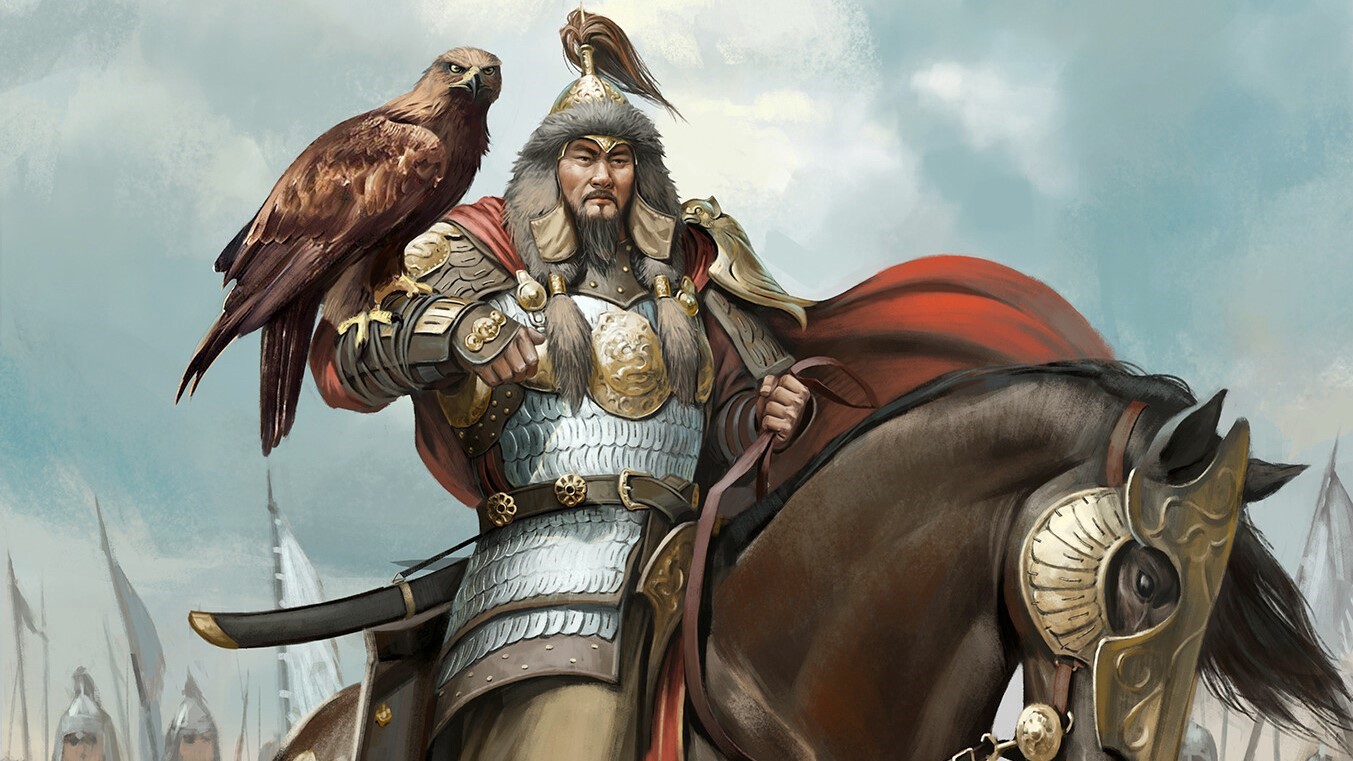
Genghis Khan Biography
Genghis Khan was a hero and leader of virtuoso who, beginning from dark and unimportant beginnings, brought every one of the traveling clans of Mongolia subject to himself and his family in an unbendingly focused military state. He then turned his consideration toward the settled people groups past the lines of his itinerant domain and started the series of missions of loot and success that at last conveyed the Mongol armed forces similar to the Adriatic Sea in one heading and the Pacific shoreline of China in the other, prompting the foundation of the incomparable Mongol Empire. Verifiable foundation Except for the adventure like Secret History of the Mongols (1240?), just non-Mongol sources give close contemporary data about the existence of Genghis Khan. Practically all journalists, even the individuals who were in the Mongol assistance, have harped on the tremendous annihilation fashioned by the Mongol intrusions. One Arab student of history transparently communicated his shock at the memory of them. Past the range of the Mongols and depending actually data, the thirteenth century recorder Matthew Paris considered them a "awful country of Satan that spilled out like fiends from Tartarus so they are appropriately called Tartars." He was making a pun with the old style word Tartarus (Hell) and the antiquated ancestral name of Tatar borne by a portion of the migrants, however his record gets the fear that the Mongols evoked. As the pioneer behind the Mongol country, the coordinator of the Mongol militaries, and the virtuoso behind their missions, Genghis Khan should share the standing of his kin, despite the fact that his commanders were oftentimes working all alone, a long way from direct oversight. In any case, seeing the Mongol missions as erratic invasions by groups of raiding savages would be mixed up. Nor is it valid, as some have assumed, that these missions were some way or another achieved by a dynamic drying up of Inner Asia that constrained the travelers to search for new fields. Nor, once more, were the Mongol attacks an interesting occasion. Genghis Khan was neither the first nor the last migrant victor to burst out of the steppe and threaten the settled outskirts of Eurasia. His missions were simply bigger in scale, more fruitful, and more enduring as a result than those of different pioneers. They encroached all the more savagely upon those inactive people groups who had the propensity for keep occasions recorded as a hard copy, and they impacted a larger piece of the Eurasian mainland and a wide range of social orders. Two social orders were in consistent contact, two social orders that were unfriendly together, if by some stroke of good luck in light of their entirely gone against lifestyles, but these social orders were reliant. The wanderers required a portion of the staple results of the south and desired its extravagances. These could be had in terms of professional career, by burdening transient processions, or by outfitted attacks. The settled people groups of China required the results of the steppe less significantly, yet they couldn't overlook the presence of the migrant brutes and were perpetually engrossed with opposing infringement by some means. A solid administration, like the seventeenth century Manchu, could broaden its tactical power straight over all Inner Asia. At different times the Chinese would need to set up one bunch of brutes to contend with another, moving their help and shuffling their collusions in order to keep any one clan from turning out to be excessively solid. The pattern of dynastic strength and shortcoming in China was joined by another cycle, that of solidarity and discontinuity among the people groups of the steppe. At the pinnacle of their power, a traveling clan under a decided pioneer could enslave different clans to its will and, assuming everything going on in China was one of shortcoming, could expand its power past the steppe. In the end this expansion of itinerant control over the contradictory, stationary culture of the south brought its own enemy. The travelers lost their customary premise of predominance that lightning versatility that necessary minimal in the method of supply and grain and were gobbled up by the Chinese they had won. The cycle would then be continued; a strong China would reappear, and chaos and trivial quarreling among vaporous clan leaders would be the new example of life among the migrants. The historical backdrop of the Mongol triumphs outlines this investigation impeccably, and it is against this foundation of political differences and strains that the existence of Genghis Khan should be assessed. His missions were not a mystifying regular or even un deniable disaster however the result of a situation con trolled by a warrior of aspiration, assurance, and virtu oso. He tracked down his ancestral world prepared for unification, when China and other settled states were, for some explanation, at the same time in decline, and he took advantage of the present circumstance. Early battles Chapter by chapter list Different dates are given for the introduction of Temüjin (or Temuchin), as Genghis Khan was named after a crushed by his pioneer father, Yesügei, when Temüjin was conceived. The order of Temüjin's initial life is unsure. He might have been brought into the world in 1155, in 1162 (the date inclined toward today in Mongolia), or in 1167. As indicated by legend, his introduction to the world was promising, on the grounds that he appeared on the scene grasping a co agulation of blood. He is additionally said to have been of heavenly beginning, his most memorable progenitor having been a dark wolf, "brought into the world with a fate from paradise on high." Yet his initial years were everything except promising. Whenever he was nine, Yesügei, an individual from the regal Borjigin family of the Mongols, was harmed by a band of Tatars, one more traveling individuals, in duration of an old fight. With Yesügei dead, the rest of the group, drove by the opponent Taychiut family, deserted his widow, Höelün, and her kids, considering them too feeble to even think about practicing authority and jumping all over the chance to usurp power. For a period the little family driven an existence of outrageous neediness, eating roots and fish rather than the typical migrant eating regimen of sheep and horse's milk. Two tales outline both Temüjin's perplexed conditions and, all the more altogether, the power he previously had of drawing in allies through sheer power of character. Whenever he was caught by the Taychiut, who, as opposed to killing him, kept him around their camps, wearing a wooden collar. One evening, when they were devouring, Temüjin, seeing that he was uncouthly watched, thumped down the guard with a blow from his wooden collar and escaped. The Taychiut scanned the entire night for him, and he was seen by one of their kin, who, dazzled by the fire in his eyes, didn't decry him however assisted him with getting away at the put of his own life in extreme danger. On another event horse cheats came and took eight of the nine ponies that the little family claimed. Temüjin sought after them. On the manner in which he halted to ask a youthful outsider, called Bo'orchu, assuming he had seen the ponies. Bo'orchu promptly left the draining he was occupied with, gave Temüjin a new pony, and set out with him to assist with recuperating the lost monsters. He declined any award be that as it may, perceiving Temüjin's position, joined himself permanently to him as a nökör, or free sidekick, leaving his own loved ones. Temüjin and his family clearly safeguarded a signific ant asset of eminence as individuals from the regal Borjigin tribe, disregarding their dismissal by it. In ad dition to other things, he had the option to guarantee the spouse to whom Yesügei had pledged him not long before his passing. Be that as it may, the Merkit public, a clan living in northern Mongolia, had hard feelings, on the grounds that Yesügei had taken his own significant other, Höelün, from one of their men, and in their turn they violated Temüjin's better half Börte. Temüjin felt ready to interest Toghril, khan of the Kereit clan, with whom Yesügei had the relationship of anda, or sworn sibling, and around then the most remarkable Mongol ruler, for help in recuperating Börte. He had the foreknowledge to revive this companionship by giving Toghril a sable skin, which he, at the end of the day, had gotten as a marriage gift. He appears to have had nothing else to offer; yet, in return, Toghril vowed to rejoin Temüjin's dissipated individuals, and he is said to have recovered his guarantee by outfitting 20,000 men and convincing Jamuka, a childhood companion of Temüjin's, to supply a military also. The differentiation between Temüjin's desperation and the tremendous armed force outfitted by his partners is difficult to make sense of, and no power other than the story of the Secret History is accessible. Ascend to force of Genghis Khan With strong partners and his very own power, Temüjin directed the Merkit, with the assistance of a system by which Temüjin was routinely to scotch the seeds of future resistance. He attempted never to leave a foe in his back; years after the fact, prior to going after China, he would initially ensure that no migrant chief made due to betray him. Not long after the annihilation of the Merkit, he treated the honorability of the Jürkin group similarly. These rulers, probably his partners, had benefitted by his nonappearance on an attack against the Tatars to loot his property. Temüjin annihilated the family honorability and accepted the average folks as his own soldiery and workers. Whenever his power had developed adequately for him to take a chance with a last standoff with the imposing Tatars, he previously crushed them in fight and afterward butchered every one of those taller than the level of a truck pivot. Probably the youngsters could be anticipated to grow up oblivious to their past character and to become faithful adherents of the Mongols. At the point when the collusion with Toghril of the Kereit finally separated and Temüjin needed to discard this deterrent to preeminent power, he scattered the Kereit nation among the Mongols as workers and troops. This savagery was not simple wanton remorselessness. Temüjin expected to leave alive none of the old, rival blue-bloods, who could demonstrate a focal point of opposition; to give himself a battling power; and, most importantly, to squash the sense Last modified: 23 Apr. 2022